Industry
Tool Control for Military and Defence Programmes
Where tool accountability is a written requirement, kits are named by role, and every tool leaving a flight line has to be accounted for before the aircraft moves.
Military tool control is the strictest version of this discipline, and the most explicit. Tools are counted before and after, kits are built by role rather than by trade, and accountability is a written requirement with consequences rather than a good practice.
How military kitting differs
Kits are named by role and by task. Not "sheet metal kit" but the kit a specific position uses for a specific job: crew chief, flight line, armament, hydraulics, fuel, engine. US suppliers in this segment organise their whole catalogue that way, by service and by role, and it is the right model because it matches how the work is assigned.
Counts are formal. A tool check is a recorded event at issue and at return, often before an aircraft is released to move. That makes readability the whole design requirement: a kit that takes ten minutes to verify will be verified badly under time pressure.
Standardisation across many identical boxes matters more than the perfect layout. When forty boxes share one layout, a technician can work out of any of them. A slightly worse layout applied consistently beats a better one applied once.
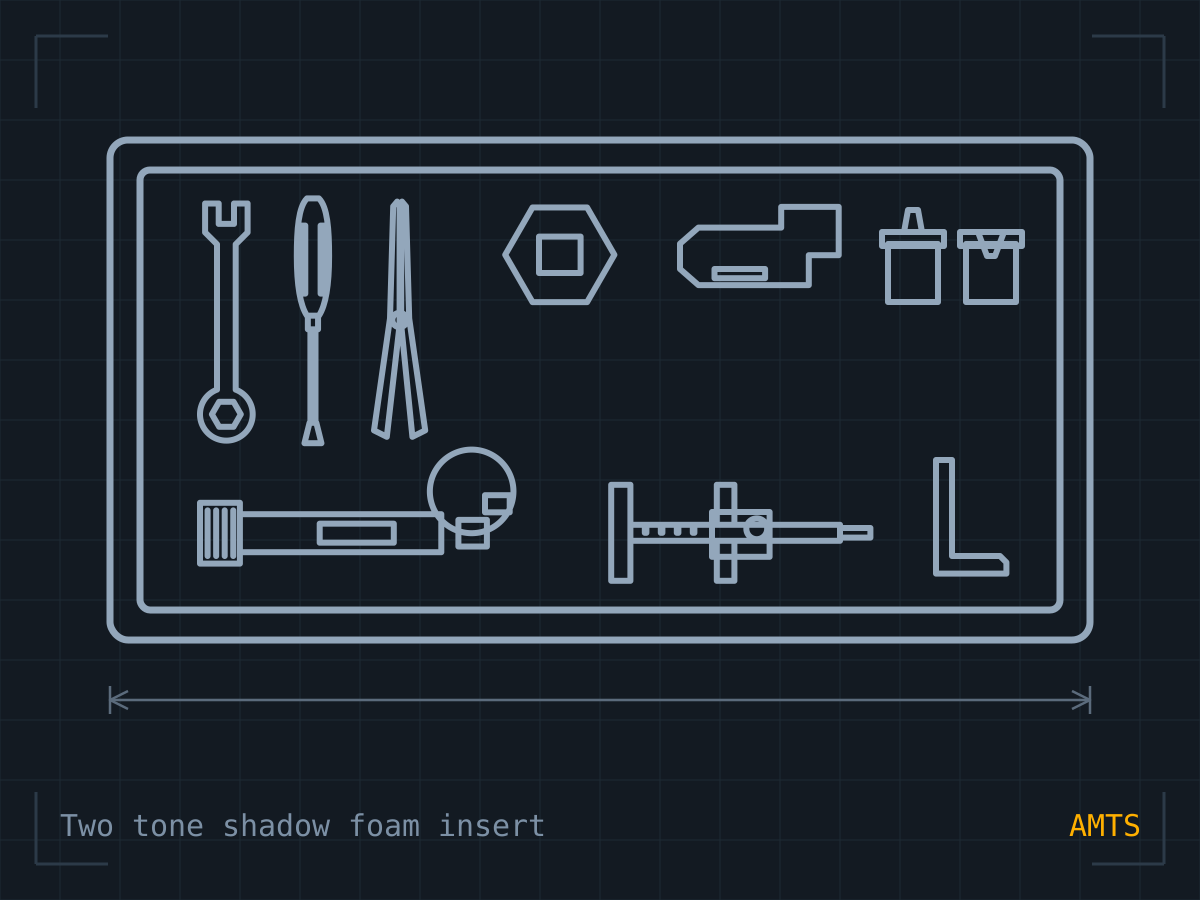
Shadowing is expected to replace marker pen. Drawing round tools with a marker was the old way of showing where things live. A cut two tone pocket does the same job permanently, and does not need redrawing every time a drawer is cleaned.
What we supply
Two tone shadow foam with numbered pockets, cut per box and repeated across a fleet of identical boxes. Etched serialisation and 2D barcodes for scan in and scan out. Role based kits built to a customer tool list. A survey and reconciliation of what is actually held, which on a programme that has been running for years is usually the most valuable part.
Repeat layouts are much cheaper than the first, and a programme of identical boxes is the case where that matters most, so it is worth telling us the total quantity at the enquiry stage rather than ordering one and coming back.
What we cannot do, stated plainly
This section exists because in defence procurement an unclear supplier claim is worse than a capability gap.
- We hold no CAGE code and no government contract vehicle. We are not on a GSA schedule or any equivalent framework.
- We hold no facility security clearance and no accreditation to handle classified information.
- We are not an approved maintenance organisation and we do not certify or release parts.
- We hold no quality management certification we can evidence today, including AS9100.
- We are not a NAVAIR, NATO or national programme approved supplier, and we do not represent that our products meet any specific service tool control manual unless you send us that manual and we build to it as a customer specification.
If any of those is a gate for your procurement route, we will not pass it today, and telling you at the first email is cheaper for both of us than a supplier questionnaire that ends the same way. Where the route allows a commercial supplier working to a customer specification, that is work we can do.
What we will do is build to a manual you provide, document exactly what was done, and make no claim about compliance that you cannot verify yourself.
Working to your specification
Send the tool control chapter of the relevant manual with the enquiry. Layouts, pocket numbering, marking format and the contents of each role kit are then built to it rather than to our preference, and the quote references the document revision so there is no ambiguity later about which version was built.
Questions from buyers like you
Do you have a CAGE code or a GSA contract?
No. We hold no CAGE code, no government contract vehicle and no framework agreement. If that is a gate for your procurement route we will not pass it, and it is better to know at the first email.
Can you build to a service tool control manual?
Yes, as a customer specification. Send the relevant chapter and the revision, and the quote and the build reference that revision. We will not claim compliance with a manual we have not been given.
Do you hold a facility security clearance?
No, and we cannot handle classified information or classified drawings. Send only material you are permitted to release to a commercial supplier.
Can you repeat one layout across a whole fleet of boxes?
Yes, and it is the case where this work is most cost effective, because the layout is drawn once. Tell us the total quantity at the enquiry stage rather than ordering one box and coming back.
Can pockets be numbered to our inventory scheme?
Yes. Send the numbering format and the pockets are marked to it, so a gap points straight at a line on the inventory sheet.
Do you supply serialised tools with barcodes?
Yes. Etched serials and 2D data matrix codes, either on tools we supply or on tools you send us, continuing an existing sequence where you have one.